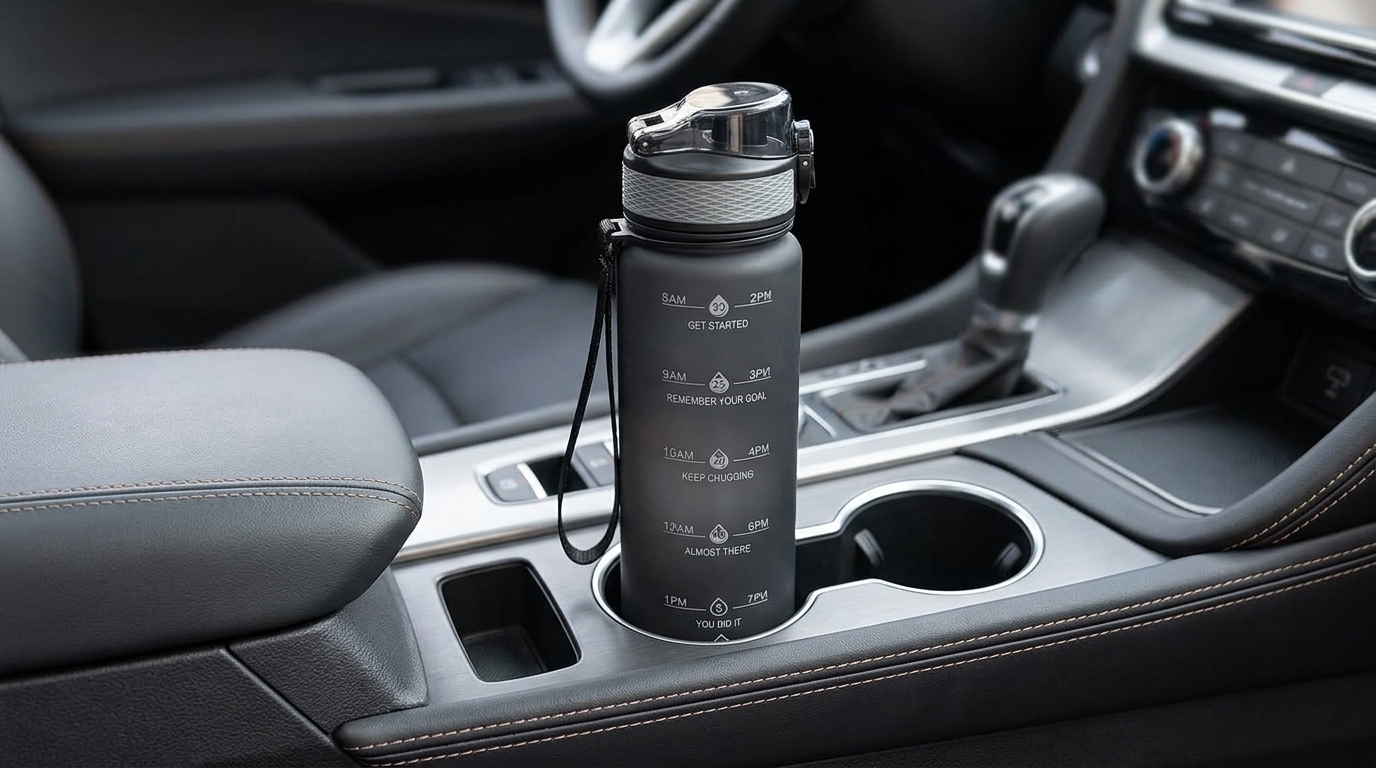
If you’ve ever bought a great insulated bottle only to discover it won’t sit in your car’s cup holder (or it wedges in so tight you have to wrestle it out), you’re not alone. Cup holders vary a lot by vehicle, and many popular bottles are designed wide for stability on desks—exactly the opposite of what most cars need.
Hyeta pick
A simple place to start
If you want a practical motivational water bottle with time markers, a straw lid, and a carry strap, compare the current Hyeta options before you choose a size.
This guide walks you through what to measure, simple fit rules-of-thumb, a “common sizes” cheat sheet (not a universal standard), and commuter-friendly features to prioritize. There’s also a quick checklist you can save or print before your next bottle purchase.
Why so many insulated bottles don’t fit cup holders
- Wide bases for stability: Many vacuum-insulated bottles use a broader base to reduce tipping on flat surfaces.
- Handles and side grips: Some handle styles flare out near the base or create a “catch point” that bumps the cup holder rim.
- Boots/sleeves add bulk: Silicone boots and protective sleeves are great for reducing dings—but they increase base diameter.
- Vehicles differ: Some cup holders are deep and narrow; others are shallow and wide; some have flexible tabs that help a little, others don’t.
What to measure (takes 2 minutes)
To choose an insulated water bottle that fits cup holder reliably, you need two numbers: your cup holder opening diameter and the bottle’s base diameter.
1) Measure your cup holder opening diameter
- Best tool: a ruler or measuring tape. A pair of calipers is even better if you have one.
- How: measure the inside width across the cup holder at the top rim (straight line across the center).
- If your holder has flexible tabs: measure the “resting” diameter, then gently press the tabs and estimate the expanded diameter too.
2) Measure (or confirm) your bottle’s base diameter
- Turn the bottle upside down and measure the widest point of the base.
- If you use a silicone boot or protective base cover, measure with it on.
- Don’t use the advertised “diameter” unless you know it refers to the base—many listings show body diameter, which can be wider or narrower than the base.
3) Leave a little “wiggle room”
A snug fit is good; an ultra-tight fit can be annoying and can scuff the bottle’s base over time. As a general rule, try to keep at least a small margin between cup holder opening and bottle base. If your cup holder has rubber grips/tabs, you may be able to go slightly tighter without rattling.
Fit rules-of-thumb (quick decision guide)
Use these simple rules to shortcut the decision when you’re shopping and comparing water bottle cup holder size details:
- Prioritize a narrow base. For commuting, a narrow base water bottle is usually more important than a narrow body.
- Tall + narrow tends to fit better than short + wide. Just make sure it won’t interfere with your shifter, infotainment controls, or armrest.
- Handles are the #1 surprise fit issue. Avoid handles that flare out near the bottom third of the bottle if you rely on a tight cup holder.
- Boots change everything. If you love a silicone boot for quiet set-downs, confirm the base diameter with the boot installed.
- When in doubt, choose slightly smaller. A bottle that’s easy to insert/remove gets used more often than the “perfect” one you dread handling in the car.
“Common sizes” cheat sheet (not universal standards)
There isn’t a single standard for cup holders or bottle bases. Still, these categories can help you think through what you’re likely dealing with when you see a listing that doesn’t provide clear measurements.
| What you’re shopping for | What often happens in cars | Best bet for commuting |
|---|---|---|
| 20–24 oz insulated bottles | Often fit more cup holders due to smaller bases | Great if you refill at work/gym |
| 28–32 oz bottles (common daily size) | Can be hit-or-miss depending on base design | Look for tall/narrow designs; check base diameter carefully (especially if you’re wondering about 32 oz bottle cup holder fit) |
| 40 oz “tumbler style” with handle | Some fit; many are tall and can bump controls; handle can snag | Only if you know your vehicle cup holders are roomy and deep |
| 64 oz+ bottles | Rarely fit standard cup holders | Better for desk/hiking; for cars, store in a door pocket or use a bottle carrier |
Commuter feature set: what matters in the car
If you’re looking for the best water bottle for commuting, fit is only half the battle. The other half is a bottle that behaves well in a moving vehicle.
Compare before you buy
Check colors, sizes, and current price
Availability and colors can change, so it is worth checking the live Amazon listing before you decide.
Leakproof (really leakproof)
- Look for a lid design that’s intended for bags and bumps—especially if the bottle will ride on a seat, floor, or backpack.
- Check that the straw or spout seals properly when closed. If you routinely toss your bottle into a gym bag, leak resistance is non-negotiable.
Easy one-handed open/close
For safety, open or adjust your bottle only when parked. But even then, commuters typically prefer lids that open/close quickly without fiddly parts.
Quiet sipping and quiet set-downs
- A soft straw or well-designed spout can reduce the “slurp” factor.
- A silicone base boot can reduce rattles and clunks in the cup holder—just remember it may affect fit.
No condensation on the outside
Vacuum insulation helps prevent condensation and keeps your console area drier and cleaner. If you’ve ever had a sweaty bottle ring in the cup holder, you’ll appreciate this.
Travel tips: making a bottle work in more cars
Even a great travel water bottle for car use can behave differently across vehicles. Here are practical ways to improve compatibility and reduce annoyance:
- Skip bulky add-ons near the base. Stickers and sleeves are fine, but avoid anything that adds thickness at the bottom.
- Choose a bottle with a smooth, straight base. Weird contours and flared shapes are more likely to snag.
- Keep it upright when possible. If your bottle doesn’t fit securely, store it in a door pocket or secure it in a bag rather than letting it roll on the seat.
- Be mindful of the handle footprint. A handle that looks convenient may stop the bottle from dropping into the holder cleanly.
- Consider a protective boot only after confirming fit. Boots can be fantastic for noise and durability, but they’re a frequent source of “why doesn’t this fit anymore?”
Quick compatibility checklist (save/print)
- Measure cup holder opening diameter (and any expansion from flexible tabs).
- Measure bottle base diameter (with boot/sleeve installed, if you’ll use one).
- Confirm the bottle can sit fully down without a handle catching on the rim.
- Check height: will it interfere with the shifter, buttons, or armrest when placed in the holder?
- Prioritize leak resistance if the bottle might tip on a seat or floor.
- Choose an easy-open lid you can manage when parked.
- Prefer a design that won’t sweat/condense around your console.
- If you share cars: test in the tightest cup holder you use most often.
A commuter-friendly option to compare
If you like a practical, everyday size for work, gym, or errands, a 32 oz bottle is a sweet spot for many people—big enough to reduce refills, but not so massive it becomes awkward in a car.
You can check the Hyeta 32oz bottle on Amazon to compare the lid style, straw format, and overall shape for commuting. If you’re narrowing options based on aesthetics, it also helps to compare current colors on Amazon before you commit.
How to decide if it’s right for your car
- Measure your cup holder opening first, then compare it to the bottle’s base.
- If you use a boot, factor that into your measurement from day one.
- Think through your commute: Do you carry the bottle in a bag? Do you prefer straw sipping? Do you need quick access at stoplights (again—open/close when parked)?
If it checks your boxes, you can see the latest price on Amazon and confirm the current listing details.
Common mistakes that lead to poor cup holder fit
- Only checking capacity (oz), not base diameter. Two “32 oz” bottles can have very different bases.
- Assuming all car cup holders are the same. A bottle that fits your partner’s car may not fit yours.
- Forgetting add-ons. Boots and thick sleeves can turn a “fits fine” bottle into a no-go.
- Ignoring handle geometry. Handles can make a bottle effectively wider in exactly the wrong place.
Bottom line
The easiest way to get an insulated bottle that fits your car cup holder is to match measurements—cup holder opening diameter to bottle base diameter—then sanity-check for handle interference and height. If you want a simple commuter-ready comparison option, you can also review the Hyeta 32oz water bottle on Amazon and see whether its design aligns with your car setup and daily routine.
Do the two-minute measuring step once, keep the checklist handy, and you’ll avoid the most common “great bottle, wrong base” regret.