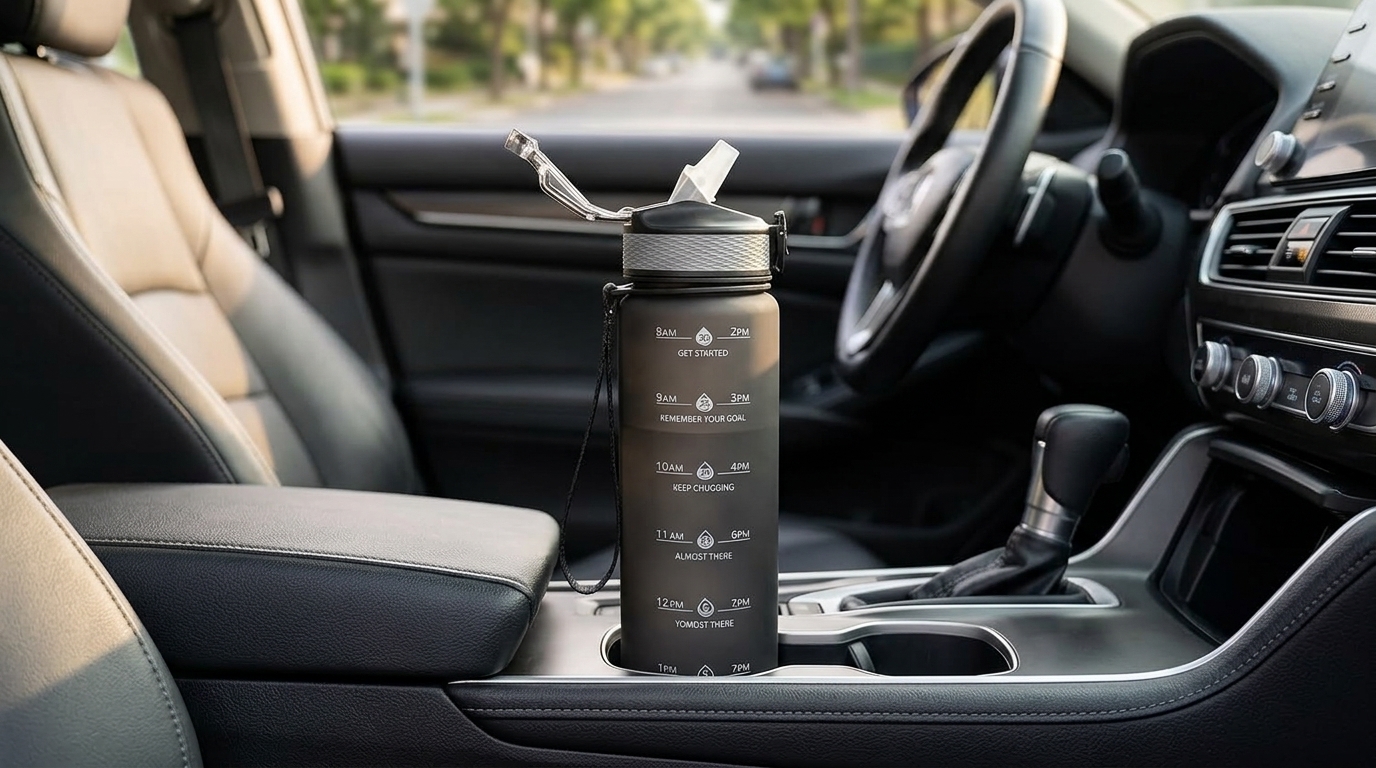
A “water bottle that fits in cup holder” isn’t really about ounces—it’s about the base diameter, the bottle’s shape, and how it interacts with your console’s depth and grip. A 32 oz bottle can fit perfectly in one car and be a constant annoyance in another.
Hyeta pick
A simple place to start
If you want a practical motivational water bottle with time markers, a straw lid, and a carry strap, compare the current Hyeta options before you choose a size.
This guide is decision-first: you’ll measure your cup holder in two minutes, match it to bottle diameter/shape, and then choose a capacity that works for commuting, school, work, and travel.
Why ounces can mislead (diameter matters more than volume)
Volume (20 oz, 24 oz, 32 oz) tells you how much water a bottle holds, but it doesn’t tell you how wide the base is. Two bottles can both be 24 oz and still fit very differently depending on:
- Base diameter (the most important “will it fit” measurement)
- Tapered water bottle design (wider upper body, narrower base)
- Handle placement (some handles collide with console edges or armrests)
- Texture and grip (some cup holders have spring tabs that prefer a slightly narrower base)
If you’ve ever thought “my 24 oz water bottle cup holder fit should be easy,” only to find it wobbles or won’t seat fully, it’s usually a diameter or shape issue—not the ounces.
How to measure your cup holder (top opening + depth)
You don’t need special tools—just a ruler or tape measure (even a phone Notes app to record the numbers).
Step 1: Measure the cup holder opening diameter
- Measure the inside diameter across the top opening (edge to edge).
- If your cup holder has rubber tabs or spring grips, measure between the tabs at their narrowest point.
Step 2: Measure usable depth
- Measure from the top lip down to the bottom of the cup holder.
- Subtract any space taken up by removable inserts or raised bumps.
Step 3: Identify obstructions
Before you buy, look around the cup holder for things that can interfere with bottles:
- Gear shifter, infotainment knobs, or parking brake
- Armrest edges that overhang the cup holder
- Door-pocket cup holders that are shallow or angled
Use this quick table (fill it in before you shop)
Copy these numbers into your notes and compare them to bottle specs and reviews.
| What to measure | Your number | Notes |
|---|---|---|
| Top opening inside diameter | ________ | Measure at narrowest point if tabs/grips exist |
| Usable depth | ________ | Note any inserts/bump-outs |
| Nearby obstructions | ________ | Armrest, shifter, console edges, etc. |
| Ideal bottle base diameter | ________ | Usually slightly smaller than opening for easy in/out |
| Preferred lid/handle style | ________ | Straw lid, flip, handle required, etc. |
Shape types that work best in cup holders
Once you know your opening diameter, shape becomes the “comfort factor”—how stable the bottle feels and how easy it is to grab without banging into your console.
1) Tapered base (cup-holder friendly)
A tapered water bottle design is often the easiest win: the bottle can be roomy up top while staying narrow at the base. Look for product photos that clearly show a narrower lower section.
- Best for: commuting, door cup holders, and shallow holders
- Watch for: a large handle that sticks out toward the dash/armrest
2) Slim cylinder (predictable fit)
If you want the least guesswork, a slim, straight cylinder can be easier to match to your measured number because the base and body are similar. If you’re searching for a slim water bottle for cup holder use, this is the classic shape.
Compare before you buy
Check colors, sizes, and current price
Availability and colors can change, so it is worth checking the live Amazon listing before you decide.
- Best for: tight openings and cup holders with strong grip tabs
- Watch for: taller bottles can feel top-heavy if the holder is shallow
3) Wide-body bottles (often the reason “it won’t fit”)
Wide bases are the most common cause of the “it’s a 32 oz water bottle too big for cup holder” experience. Many 32 oz bottles are designed for hands and hydration first—cup holders second.
- Best for: desks, gym floors, backpack side pockets (depending on width)
- Watch for: anything that looks “jug-like” at the base
Handle placement: the overlooked dealbreaker
Even if the base fits, a handle can make the bottle annoying to live with. Look for handles that sit close to the lid (or fold down), and consider which direction the handle will face when the bottle sits in your holder.
Capacity tradeoffs: what size usually works for commuting?
There’s no universal fit, but there are practical “sweet spots” for daily driving and errands.
~20–24 oz: the cup-holder sweet spot for many people
This range often balances portability with enough water to get you through meetings, class blocks, or a short gym session—without making the bottle overly wide or heavy. If your main goal is “grab, sip, set back down,” a 20–24 oz bottle is often the easiest day-to-day choice.
~32 oz: fewer refills, but fit depends on shape
A 32 oz bottle is great when you want fewer refills—especially at work or on travel days. The catch: many 32 oz bottles have wider bases. If you’re committed to 32 oz, prioritize tapered shapes and double-check base diameter in the listing details and reviews.
If you’re considering a larger option, you can check the Hyeta bottle on Amazon and compare how the base shape and handle placement look for your console setup.
How to match bottle diameter to your cup holder (a simple rule of thumb)
When shopping online, the key number to look for is the cup holder water bottle diameter at the base. If the listing doesn’t provide it, use product photos and reviews to infer whether it’s tapered or wide-bodied.
- If your holder is tight: choose a base that’s clearly smaller than your measured opening so you can insert/remove one-handed.
- If your holder has grip tabs: a slightly slimmer base can still be stable because the tabs press in.
- If your holder is shallow: avoid tall, top-heavy bottles that can wobble when you turn.
Quick checklist before buying online
- Base diameter: Confirm it’s compatible with your measured opening.
- Shape: Prefer tapered or slim cylinder if fit is your #1 priority.
- Depth & stability: If your cup holder is shallow, be extra cautious with tall bottles.
- Lid style: Straw lids can be great for driving (less tilting), but make sure they’re easy to clean and seal well.
- Handle placement: Visualize where the handle will sit relative to your console/armrest.
- Leak resistance: Helpful for commuting, especially if the bottle will tip in a bag between car and office.
A practical pick if you want 32 oz (and still care about carry)
If you want to lean into fewer refills, a 32 oz bottle can be a solid daily driver—just be realistic about cup holder fit and verify the base shape before ordering. The Hyeta 32oz Water Bottles with Straw on Amazon is a convenient option for people who prefer a straw lid and want easy sipping during commutes and workdays.
- If you’re unsure, see the latest price on Amazon and scroll the listing images/reviews to confirm how it sits in real-world cup holders.
- If you like to match gear, you can also compare current colors on Amazon before you commit.
Conclusion: measure once, buy with confidence
The easiest way to end the cup-holder guessing game is to measure your holder’s opening and depth, then shop based on base diameter and shape—not just ounces. If portability is your priority, many people find ~20–24 oz the least fussy. If you want fewer refills, 32 oz can work well when the base is designed with cup holders in mind.
Do the two-minute measurement, use the checklist, and you’ll dramatically reduce the chances of buying a bottle that wobbles, jams, or constantly fights your commute.